Decision guide, Gulf-specific
Private Jet Charter vs Ownership in the Gulf: Which Wins
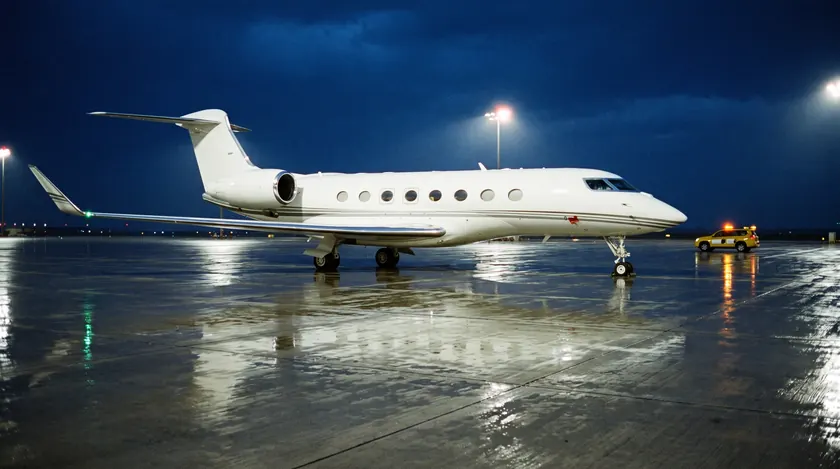
We get asked to price a jet before the client has decided whether to buy one at all. Some of them fly enough that ownership is obviously right. Others would be better served chartering indefinitely and would never notice the difference in comfort.
Here is the actual framework we use, built around Qatar Executive's charter model at one end and the direct operating costs we track for Gulf-owned aircraft at the other, not a generic global rule of thumb.
How many flight hours a year justifies buying instead of chartering?
There is no single published threshold for the Gulf specifically. The proxy we use comes from the owner-operated budgets behind our own cost estimates: a Embraer Phenom 300E is typically budgeted at 200 to 400 hours a year, an Embraer Praetor 600 nearer 450 hours. Below roughly 200 hours a year, fixed costs, hangar, insurance, a retained crew, rarely spread thin enough to beat charter. Above that, ownership usually starts winning. Run your own realistic annual hours against the aircraft's direct operating cost per hour before deciding either way, not the hours you hope to fly.
Charter vs ownership, side by side
The shape of the decision does not change much by country. What changes is which operator you are chartering from and which authority you are registering with.
| Charter | Ownership | |
|---|---|---|
| Upfront cost | None | Purchase price, from under $6M for a light jet to $84M-plus for a new Gulfstream G700 |
| What drives cost | Per-flight charter rate plus repositioning | Fixed costs (hangar, insurance, crew) plus direct operating cost per flying hour |
| Typical Gulf use case | Riyadh-Doha or Muscat-Dubai on demand, VIP long-haul on Qatar Executive's floating fleet | Standing routes for a family office or corporate flight department, or a status asset for a sovereign-linked buyer |
| Registration exposure | None, it sits with the operator | HZ-, A7-, A4O- or A9C- registration, or an offshore mark, is now your paperwork to manage |
| Where the risk sits | With the operator | With the owner: engine programs, service bulletins, resale value |
Is fractional jet ownership available in the Gulf?
We do not see an established, Gulf-based fractional programme in our market data. Owners here typically choose full ownership or ad hoc and block charter instead. If a fractional card from an international provider is being sold to you, confirm specifically whether it covers positioning into Gulf airports, that is usually where an imported fractional programme's economics break down fastest for a Riyadh, Doha or Muscat-based buyer.
Does Qatar Executive offer jet cards or only on-demand charter?
Qatar Executive runs a floating fleet model, repositioning aircraft globally to meet charter demand rather than basing them against a fixed card programme. Its fleet is built around scale at the top end: it is the world's largest commercial operator of the Gulfstream G650ER with 15 aircraft, and the launch commercial operator of the Gulfstream G700 with 9, alongside 2 Bombardier Global 5000s and an Airbus A319CJ. Clients arrive and depart through its dedicated Premium Terminal at Hamad International, opened in 2016, while the actual FBO, aircraft management and maintenance operation sits at Doha International Airport (DIA), the former commercial field that closed to scheduled traffic in May 2014. We do not have published jet-card pricing for Qatar Executive in our data. Treat on-demand charter as the model to ask about, and confirm card availability directly with them.
What is the average cost of a private jet charter in Saudi Arabia or Qatar?
We do not have a published, country-specific charter rate card for either market, and we would question anyone who quotes one without knowing the route and aircraft. Charter pricing is built off the aircraft's direct operating cost plus a margin and repositioning, so a Riyadh-based charter on Sky Prime and Alpha Star's Gulfstream G450s and G550s prices very differently from a Qatar Executive G650ER repositioned into Doha. Send us the route and aircraft class and we will get you a live quote rather than a stale number.
Prefer to just ask? Send a short message, we reply the same day.
Ask a questionWhat hidden costs come with owning a private jet?
- Engine program enrollment and the reserve it draws down between overhauls
- Landing gear overhaul cycles, tracked by time and cycles, not calendar age
- Airframe corrosion inspection, especially relevant at humid Gulf coastal bases
- Cabin connectivity and interior refurbishment as the aircraft ages, which the resale market increasingly prices in
- Insurance and hangar, which accrue whether the aircraft flies or sits
- Registration and paperwork upkeep with GACA, QCAA, PACA or Bahrain's CAA, or with an offshore registry instead
Is chartering cheaper than owning for occasional flyers in the region?
Generally yes, and the hours logic in the first section holds up well in practice. Chartering also hands resale risk and airworthiness-directive surprises entirely to the operator, which is part of what the charter rate is pricing in. If you are occasional today but expect that to change, our guides on private jet operating costs in the Gulf and buying a pre-owned private jet are the natural next stops once your hours start climbing.
A four-step way to decide
- Total your realistic annual hours, not an optimistic number.
- Price the direct operating cost per hour for the aircraft class you would actually buy.
- Add fixed annual costs, hangar at your likely base plus insurance and crew.
- Compare that total against what the same missions would cost on charter, hour for hour, including repositioning, then revisit charter options in Saudi Arabia or in Qatar with real numbers instead of a guess.
Frequently asked questions
Does chartering ever make sense for a very frequent flyer?
Sometimes, if routes vary enough that no single aircraft fits every mission. An owner flying Riyadh-London twice a year and Riyadh-Jeddah weekly may still be better off chartering the London legs on a larger aircraft while running a smaller owned jet for the shuttle work.
What is the single biggest cost people forget when comparing charter to ownership?
Repositioning. An owned aircraft based in Riyadh still flies empty to collect you if you are starting from Jeddah, and a chartered aircraft often bills that empty leg too. Include it on both sides of the comparison, not just the hours flown with passengers aboard.
Do operating costs differ much between a large-cabin jet and an ultra-long-range flagship?
Substantially. A Gulfstream G450 runs around $7,496 an hour in direct operating cost, while a Gulfstream G650ER runs over $6,600 an hour despite its far longer range and larger cabin, and a new Gulfstream G700 is expected to price above that again. Size the aircraft to the mission, not the aspiration.
Who carries the resale risk in each option?
In ownership, you do. Value moves with the market between purchase and sale, and thin pre-owned supply, as with the Praetor 600 or the G700, can cut both ways: it protects value but also slows a sale. Charter passes that risk entirely to the operator.
Is Qatar Executive only relevant if I am chartering out of Doha?
No. Its floating fleet repositions globally, so it is a live comparison point even for a Riyadh or Muscat-based decision, not just a Doha-local option. Ask what it would cost to reposition one of its aircraft to your actual departure airport before ruling it out.
Want the numbers run for your own flying pattern
Give us your typical routes and rough annual hours and we will tell you honestly whether charter or ownership comes out ahead.
Ask a question